
Dashboard Signals: Six Numbers Worth Checking Every Morning
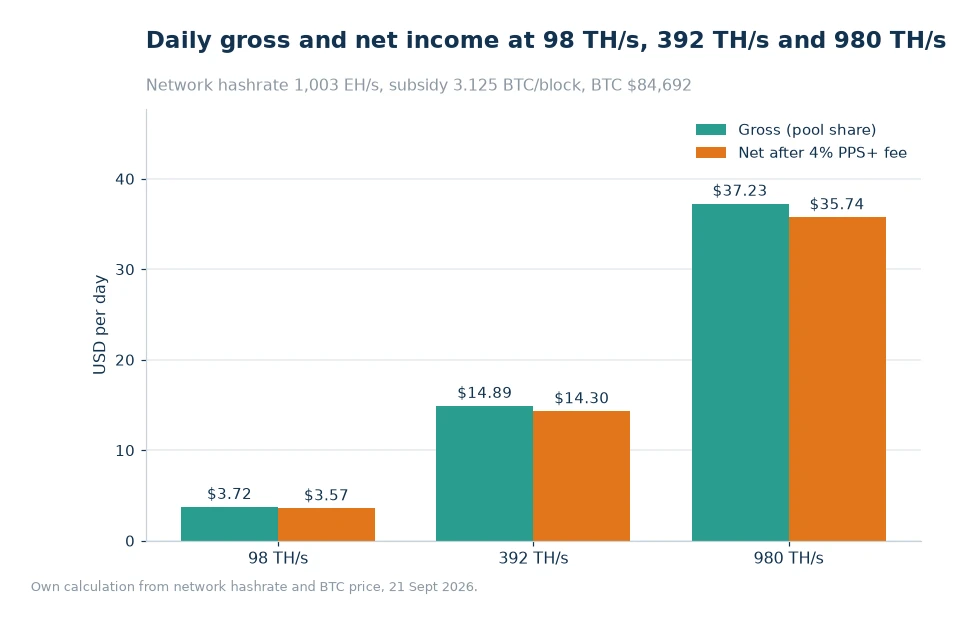
A mining dashboard shows dozens of figures and most of them are decoration; six of them decide whether the operation is healthy. At 98 TH/s the expected output is 4.396e-05 BTC a day, $3.72 at $84,692 per BTC and $3.57 after the listed 4% on the block-reward component, and every one of those six numbers is a way of asking whether that figure is actually arriving.

Key takeaways
- 98 TH/s should produce 4.396e-05 BTC a day; if the wallet shows less for a week, one of the six signals has moved.
- Reported hashrate below rated hashrate is a local problem, not a pool problem, and it costs more than any fee.
- At 980 TH/s the same schedule returns 0.00043963 BTC and $37.23 gross, $35.74 net, so small percentage faults get expensive.
- Hourly settlement gives 24 chances a day to notice a fault, which is the main operational benefit of PPS+.
Six figures, in the order they fail
The first is reported hashrate against rated hashrate. A machine rated at 98 TH/s that reports 92 is not mining at a discount; it is losing 6% of its output, which is larger than the fee difference between any two payment methods. Check this first because it is the most common fault and the easiest to fix.
The second is share acceptance. A healthy connection accepts close to every share it is sent. A rate that drifts down usually means network latency or an unstable link, and the fix is a nearer endpoint or a better router rather than a new pool. The third is the credited BTC per hour, compared with the formula on your own hashrate. That single comparison separates a local hardware fault from a settlement problem.
Temperature, power and the two figures the pool cannot see
The fourth figure is intake temperature and the fifth is fan speed, read together. A machine that holds its hashrate while fans climb towards maximum is throttling soon, and the corrective action, cleaning a filter or improving airflow, costs almost nothing compared with replacing a board. The sixth is power draw at the wall, which should sit near the rated figure and stay stable across the day.
None of those last three appear on a pool dashboard, and that is exactly why they belong in the same morning routine. The pool can only report what the machine tells it. A unit drawing 20% more power for the same hashrate is invisible to the pool and obvious on a clamp meter, and it turns a profitable machine into a marginal one without changing a single payout figure.
When a percentage fault becomes real money
The reason to care about small drifts is that the income scale is linear, so a percentage loss stays a percentage loss at every size. At 98 TH/s a 6% shortfall is worth about $0.22 a day. At 980 TH/s it is worth $2.23 a day, or roughly $67 a month, which is the price of a replacement fan several times over.
| Hashrate | BTC per day | Gross per day | Net per day | Net per week |
|---|---|---|---|---|
| 98 TH/s | 0.00004396 | $3.72 | $3.57 | $24.99 |
| 392 TH/s | 0.00017587 | $14.89 | $14.30 | $100.10 |
| 980 TH/s | 0.00043963 | $37.23 | $35.74 | $250.18 |
The weekly column is the one to keep in view. Daily numbers are noisy enough that a bad day can be weather, a restart or a difficulty change. A week that lands below the weekly figure by more than a few percent is a pattern, and patterns have causes.
Express every fault as a share of that weekly figure and the repair budget writes itself. A machine losing 6% of its output for a fortnight costs about 0.6% of the quarter's income at any size, which sounds trivial until it is compared with the price of a fan. The comparison only works if the expected weekly number is written down before the fault appears, because after the fact every result looks like it was always going to happen.
Worked example
Build the expected figure from scratch, then use it as the benchmark for the dashboard.
- Network share: 98 divided by 1,003,000,000 TH/s equals 9.771e-08.
- Daily coins: 9.771e-08 multiplied by 450 BTC equals 4.396e-05 BTC.
- Gross value: 4.396e-05 multiplied by $84,692 equals $3.72.
- Listed fee: 4% of $3.72 is $0.15, leaving $3.57 net.
- Hourly expectation: 4.396e-05 divided by 24 equals 1.83e-06 BTC.
- Four times the hash at 392 TH/s: 0.00017587 BTC, $14.89 gross, $14.30 net.
- Ten times the hash at 980 TH/s: 0.00043963 BTC, $37.23 gross, $1.49 of listed fee, $35.74 net.
- Weekly check at 980 TH/s: $250.18 expected net, so a week that returns $233 is a 6.9% shortfall worth investigating.
Alerts that earn their place
An alert is only useful if it changes an action. Four thresholds cover most of it: hashrate below 95% of rated for more than fifteen minutes, share acceptance below 99% for the same period, intake temperature above the level your site can sustain in summer, and a payout gap longer than two settlement cycles. Anything else is a notification you will learn to ignore.
The payout gap alert is the quiet one. Under hourly settlement, two missed hours is a signal; under PPLNS, a quiet stretch is normal because blocks do not arrive on a fixed schedule. Set the threshold according to your method rather than copying someone else's number.
The ViaBTC App carries real-time hashrate monitoring and alerts on iOS and Android, with multi-account management for operators running more than one site. For a single shelf of machines the phone is enough; for a farm, it is the backup channel when the desktop is not open.
A morning routine that takes four minutes
Open the pool balance and compare last night's credits with the hourly expectation. Glance at the hashrate series for a step rather than a slope: a step means a machine dropped, a slope means throttling. Then walk the room or open the enclosure app and read intake temperature and fan speed on the two hottest units. Finish by checking the power meter against yesterday.
Write the four readings down, even in a note on your phone. The value is not in any single day but in the comparison across days, and a written series catches a slow decline that a live dashboard hides. This is the least glamorous part of ViaBTC Crypto Mining and the part that decides whether the operation compounds or leaks. It also gives you something concrete to hand a technician, rather than a vague complaint that the machines seem slower this month.
Frequently asked questions
Why is my reported hashrate lower than the machine's rating?
Usually heat, a failing fan, a power supply near its limit, or a pool difficulty setting that makes short-term readings noisy. The pool sees the result, not the cause.
How much does a 6% shortfall cost at 980 TH/s?
About $2.23 a day against the $37.23 gross expectation, or roughly $67 across a month, which is usually more than the repair.
Should PPLNS miners worry about quiet payout periods?
No. PPLNS distributes when the pool finds blocks, so gaps are expected; only a gap that spans many difficulty windows is worth a query.
Measure the same six things tomorrow
Reliable mining is a comparison habit rather than a clever setup. Compute the hourly expectation for your own hashrate, write down the six readings each morning, and act on steps and thresholds instead of on impressions. The arithmetic in this article takes a minute and gives every subsequent reading something to be measured against.
Sources: pool fee and settlement terms[1], with chain inputs read 21 Sept 2026: network hashrate about 1,003 EH/s, difficulty 132.76 T, 3.125 BTC per block across 144 blocks a day and BTC at $84,692. Figures read 21 Sept 2026, published 22 Oct 2026. Shortfall examples are arithmetic on those inputs and on stated percentages, not predictions.